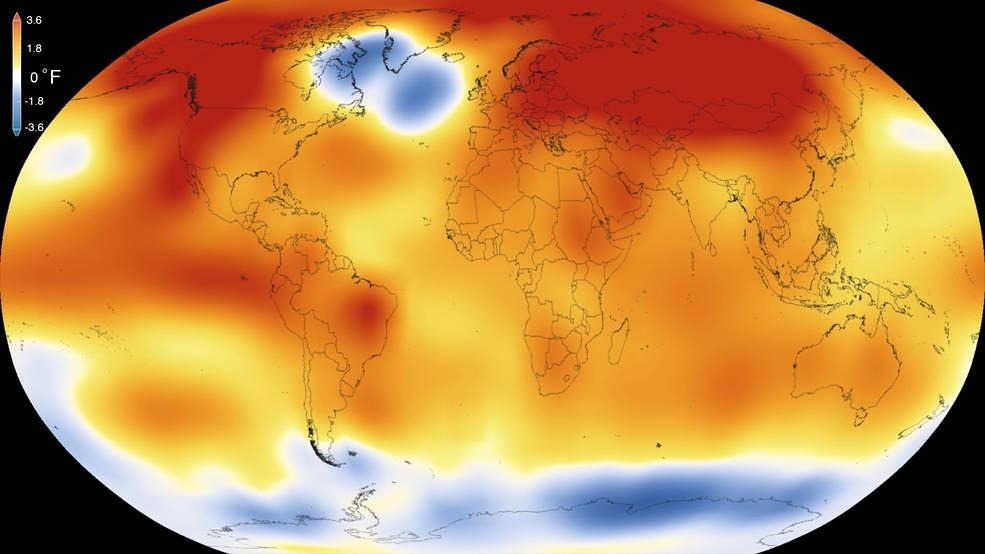
Of all the great questions of the day, the one of our future in an age of mass production and climate change is one of the most pressing and daunting. Our eyes are still opening to the catastrophic processes we initiated two hundred years ago. And it is time to begin asking: what is global warming? And what does it mean for our planet?
Since the Industrial Revolution, humans have been burning fossil fuels and producing greenhouse gases. As the world has moved into the twentieth and twenty-first centuries, this production has only ramped higher and higher, according to NASA. Greenhouse gases, such as carbon dioxide, methane, and chlorofluorocarbons, take the sun’s infrared light that is bouncing off the Earth’s surface and reflect it back at Earth, stopping it from escaping into space. To a certain degree this is good; if all of the Earth’s heat were to escape, the planet would become inhabitable; but human production is increasing greenhouse gas concentrations past sustainable levels. The result has been an alarming spike in global temperatures, known as global warming, and the unbalancing of natural climate systems, known as climate change.
What does this mean for the planet? For starters, weather events such as hurricanes and flooding are becoming more and more severe, as are wildfires. Due to the melting of glacial ice, sea levels are expected to rise one to six and a half feet by the end of the century, according to NASA. The dissolving of greenhouse gases in the ocean is causing it to acidify, harming coral reefs and shelled organisms. The Arctic is being hit especially hard, and the minimum sea ice levels have decreased by forty percent since 1978, says National Geographic. Changing weather patterns are also throwing off the timing of migrations for animals such as butterflies and birds. In order to survive, these animals rely on food sources that generally time up with the migrations. However, different species are reacting differently to the earlier seasons created by climate change, throwing off the whole system and imperiling migratory animals, notes the United States Environmental Protection Agency. Many ecosystems, it warns, have “tipping points,” where climate conditions are so extreme that the ecosystem can no longer balance itself, and as climate change worsens we could be nearing these tipping points.
Global warming paints a grim picture for the future, and it’s highly unlikely that we’ll be able to cut enough emissions to stop it in the near future. But how bad will it really be? Thomas Moore points out in the National Library of Medicine that “Certainly, the global climate will get warmer, but this, in itself, is not intrinsically bad” (Moore). He points out that warmer temperatures may increase growing seasons and create more pleasant climates, though possibly at the cost of developing nations in arid regions.
Moore does make a good point, but aspects of global warming, such as flooding and droughts, will be considerably less pleasant than these factors. As humans we have to realize that global warming will not simply abate by itself–quite the opposite. Human industrial production is inherently unsustainable and needs to be addressed now; otherwise the situation will just continue to spiral. And there is a far more meaningful reason to stop global warming while we have the chance, too. We are now facing rates of extinction on par with the worst mass extinctions in known history. Each of the hundreds of billions of creatures that will be impacted by global warming have real lives, just like we do, that we have a duty to protect.
We have to preserve our Earth and its incredible diversity now, or it may be lost forever.
Sources:
- https://education.nationalgeographic.org/resource/unbalanced-how-climate-change-shifting-earths-ecosystems/
- https://19january2017snapshot.epa.gov/climate-impacts/climate-impacts-ecosystems_.html
- https://science.nasa.gov/climate-change/effects/
- https://www.nps.gov/articles/000/wildlife-climateimpact.htm
- https://pmc.ncbi.nlm.nih.gov/articles/PMC3317379/
- https://science.nasa.gov/climate-change/causes/